


















Driving Sustainable Logistics Through Smart Innovation
Across all four of DENKINGER GmbH’s locations, Axis cameras are deployed for security. At the newly built "DENKINGER Rail-Hub," Axis cameras are additionally used for data generation and process monitoring.
Digitalization as a driver for innovation
DENKINGER GmbH is a family-run company defined by sustainability, innovation, and digitalization. With about 230 employees, the company seamlessly connects road, rail, sea, and air transport.
At DENKINGER, logistics, real estate, and energy management do not operate in silos: They form a single, interconnected ecosystem. By combining land use, power utilization, and the movement of goods, the company takes a truly holistic approach to operations.
Behind this integration is robust in-house IT expertise. DENKINGER develops intelligent digital platforms and communication structures that seamlessly link every process together. Here, digitalization is a strategic tool for value creation and process simplification, with sustainability as the guiding principle. The company operates from several locations: Rottenacker, Ehingen, Allmendingen, Ulm-Einsingen, Salgen, and Bremerhaven.
A cornerstone of the corporate strategy is the DENKINGER Rail-Hub in Rottenacker, which opened in 2023 and was awarded the renowned German Logistics Prize by the Bundesvereinigung Logistik (BVL) in 2024.
However, before this digital solution was implemented, the cargo and logistics processes were heavily manual and associated with significant risks.

Smarter steel handling eliminates rail-hub risks
At the Rail-Hub, steel sheets arrive daily on freight wagons from all over Europe. These sheets range from 2.5 to 13 meters in length and vary in levels of contamination. Every single sheet must be visually identified, cross-referenced with the database, and tagged with a warehouse label before the crane operator can set it down. Previously, employees had to climb onto the loaded wagons to read the sheet numbers manually and attach the labels. This was physically demanding, prone to error, and carried a significant risk of accidents. Two people were required for this single step: one to read the numbers and one to label.
Enhanced process optimization with network cameras
The Rail-Hub consists of two state-of-the-art halls along a two-kilometer track system, allowing entire freight trains to enter and be unloaded using heavy-duty cranes, handling excavators, forklifts, and reach stackers. The halls were constructed using timber and equipped with solar panels and their own energy storage systems.
The company also took the initiative to reactivate and expand a decommissioned rail connection to connect the north and south via rail and permanently shift traffic from road to rail. The result is a sustainable overall concept that unites logistics, digitalization, and environmental responsibility.
In each hall, Axis box cameras are mounted above the tracks and wagons. The installation and integration were carried out by Axis partner Expert Security.
Precision enables exact data matching
The process is now perfectly optimized. Axis cameras automatically capture images of the sheets in the wagons of every incoming freight train. These images are transmitted to a server for analysis. Using the Google Vision API, the sheet numbers are automatically recognized and cross-referenced with the ERP database. The system identifies the sheet, determines the storage location, grade, and melt, and automatically prints the correct label. The crane operator then sets the sheet down and attaches the label.
An additional advantage: employees can manually trigger a photo at any time to compare the live image with the database image for quality control. The open interfaces of Axis cameras allowed for a direct and uncomplicated connection to DENKINGER's existing IT infrastructure.
The Axis cameras are easy to handle, from initial setup to daily use. We are impressed by the image quality every day, especially under the changing light conditions in our open halls. The robustness of the devices gives us the confidence that we can rely on the technology, even in a harsh industrial environment
Network cameras boost logistics efficiency
The benefits of using smart technology are now clearly visible. Where two people previously worked manually on loaded wagons, the camera now handles identification: automatically, reliably, and without accident risk. This new process has significantly increased operational efficiency in logistics and enables staff at DENKINGER to leave dangerous and monotonous tasks to the technology while being able to use their expertise for other tasks. The entire process follows a clear logic: detect an event, create an image and establish a solid basis for decision-making.
A critical technical factor is image quality. Since the halls are open on the sides, lighting conditions vary significantly depending on the time of day and weather. Axis cameras deliver consistently clear, evaluable images even under these demanding conditions, which is a fundamental requirement for the automatic image recognition to function reliably.
Data protection also played a central role in the choice of technology. In addition to process optimization, additional Axis cameras are used for security.

Smarter, safer tech for modern logistics
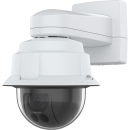
DENKINGER is already planning further innovations, such as using cameras to automatically check if helmet requirements are being met in specific areas. Another exciting project currently in the pilot phase is the remote control of crane systems via VR goggles and a joystick, based on a live 360° image from the crane, operated from the office. This project is currently being tested using Axis PTZ cameras, further pushing the boundaries of technology in logistics.
Products & solutions
You may also be interested in...


Get in touch
Want to know how you can benefit from Axis solutions? Get in touch and we will help you.
Contact us