



















Solving crimes faster with a real-time information center
Chicopee Police Department integrates Axis cameras into its Real-Time Information Center (RTIC) to understand unfolding incidents more clearly, support investigations, and coordinate responses faster across jurisdictional boundaries.
Chicopee Police at a public safety crossroad
Because Chicopee, MA, lies at the crossroads of three major interstates, its police department often handles fast-moving, high-risk incidents that cross regional boundaries. As a technology-forward operation, the Chicopee Police Department synthesizes real-time incident information from multiple sources and disseminates that data directly to its officers, investigators, and regional partners. This enables them to solve crimes more quickly and thereby better protect the community.

Planning a Real-Time Information Center
When the Chicopee Police Department took over management of the city’s modest municipal camera network, it looked for ways to turn those passive video assets into real-time operational tools. Rather than just deploying more cameras citywide, the department wanted to integrate video into a broader, real-time public safety ecosystem that could:
- Provide timely visual information and context during active incidents
- Expedite investigations with easy search of relevant information
- Analyze crime trends and recognize patterns to direct resources more effectively
- Support fluid collaboration across regional public safety agencies
With support from the mayor, city council, Hampden County Sheriff’s Department, neighboring communities, local businesses, and technology partners, Chicopee Police Department embarked on a multi-year project to bring its dream of a Real-Time Information Center (RTIC) to fruition.

Aggregating situational data via an open platform
“Siloed technology is hard to manage effectively,” states Chicopee’s Acting Police Chief Eric Watson. “So it was important for us to choose a real-time information center platform that could bring all our intelligence resources into one centrally managed system.”
Axon’s Fusus platform, an Axis technology partner, serves as the unifying intelligence layer the department required. By seamlessly ingesting live and recorded streams from Milestone Systems’ video management platform, the foundation of the city’s video infrastructure, and marrying them with real-time data like gunshot detection or TASER activation, Fusus provides a comprehensive operational picture. This allows video managed by Milestone to be viewed in the immediate context of field operations.
“Because public safety incidents tend to unfold quickly, we wanted a system that was pretty intuitive to operate,” shares William Schwarz, director of development for the Chicopee RTIC. “We went with the Axon Fusus platform because it gives us a seamless way to access and aggregate data from our entire technology ecosystem through a single pane of glass.”
That ecosystem includes:
- The city’s Axis cameras and license-plate readers
- Officer body worn cameras
- In-cruiser cameras
- Local business-owned cameras that allow video sharing

The Axon Fusus platform also integrates law enforcement technologies such as gunfire detection and roadway intelligence into the RTIC, tying capabilities like stolen vehicle alerts, computer-aided dispatch, and artificial intelligence together to provide a comprehensive view of ongoing incidents. And plans are already underway to link more than 750 exterior cameras from the city’s schools to the RTIC.
With programmed alerts for high-risk incidents and other timely intelligence, Fusus helps RTIC analysts and dispatchers make informed decisions quickly. “Fusus maps the location of all our resources,” explains Watson. “So, for instance, if an officer calls in for help, our dispatcher can draw a circle around that officer’s location and Fusus will pull up all the camera views in that vicinity. In a split second they can see and understand exactly what’s happening and take appropriate action.”

Choosing the right cameras for situational awareness
Before installing any new cameras in the city, the department uses AXIS Site Designer to map out placement and visualize coverage so that there aren’t any blind spots. They use the software in conjunction with AXIS Product Selector to help them determine the best cameras and specific features for each location.
“When seconds matter, Axis cameras give officers the situational awareness they need to stay safe and make informed decisions that ultimately impact outcomes,” says Watson.
“Axis cameras have proven to be a good investment for Chicopee,” says Watson. “They not only deliver consistently high image quality, but they also last a long time. Some of our cameras have been running for nearly 10 years.” Because the cameras have such a long lifecycle, the department has been able to channel replacement savings into adding more cameras throughout the city.
Strategic camera placement yields fast results
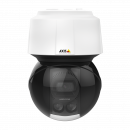
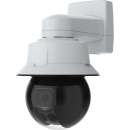
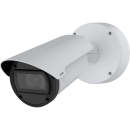
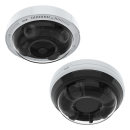
To amplify public safety, Chicopee uses a mix of cameras:

A typical intersection installation, for example, includes a PTZ, a multisensor panoramic, and several LPR solutions pointing in different directions. Critical infrastructure – like City Hall, the wastewater pumping stations, the police and fire department – are covered by pan, tilt, roll, zoom (PTRZ) cameras that support remote readjustment to minimize maintenance calls.
“The goal is to cover as large a viewing area as possible to maximize our situational awareness,” says Watson. “And it’s really paying off.” Analysts routinely jump on Axon Fusus and use its AI to quickly search video by criteria such as a vehicle’s direction or license plate, an individual’s attire or tattoos, or other characteristics to help officers apprehend suspects or uncover critical details detectives need to propel their investigations.
When seconds matter, Axis cameras give officers the situational awareness they need to stay safe and make informed decisions that ultimately impact outcomes.
Accelerating missing person searches
As a real-time operational tool, Chicopee’s RTIC continues to impress. Watson shared the story of a missing person whose last known location was at the police station. Thirty-six hours later that individual was reported missing. “With a little help from AI, our analysts pulled up the relevant camera footage and tracked him from the time he left the station to where they eventually found him. Once he was located, they dispatched an officer to get him help,” shares Watson. “But what’s really amazing is that the search took our team less than 10 minutes.”
Routinely catching shoplifters
Chasing shoplifters is part of the daily routine for Chicopee police officers. Nowadays, that job is much easier because a great many of the stores being targeted are near major intersections – exactly where the city has installed clusters of cameras. When an active theft alert comes into the RTIC, analysts immediately jump onto the cameras to track suspects in real time. “As they’re following those shoplifters from camera to camera, they’re on the radio updating officers on which direction those individuals are fleeing, what they’re wearing and so on,” reports Schwarz. “When officers pull up to make an arrest, these guys always seem so surprised that we knew exactly where to find them.”
Handling a student protest safely
When students from the local high school staged a protest walk to City Hall, Chicopee Police drew on all its camera resources to keep everyone safe. “We were able to monitor the entire one-mile walk, keeping a close eye on interactions between the protesters and any anti-protester,” recalls Schwarz.
“From an incident command standpoint, having all that visual data coming into the RTIC helped us know where to position cruisers, whether we needed to shut down streets, or send more resources to the area if it looked like a problem was starting to brew,” shares Eric Watson.
Lightening the caseload with faster resolution
Sometimes information becomes available so quickly that an analyst can gather all the evidence even before an officer is assigned to the case. Schwarz tells of an instance where a detective came in at shift change and thanked one of the analysts for solving a case he hadn’t yet known he had. “She had already reviewed and extracted the relevant video, identified the owner of the vehicle, grabbed a picture of his driver’s license and compared his image to what the camera caught, and sent the whole package to the detective’s email,” recounts Schwarz. “Think of the time savings.”
Watson also notes the positive impact video is having on prosecuting offenders. “Video clips often do more to convince a jury than just listening to officer and witness testimony.
We don’t expect technology like cameras and the RTIC to replace boots on the street. They just make an officer’s job a whole lot easier.
Real-time information sharing boosts public safety
Chicopee’s RTIC has quickly grown into a valued regional real-time information resource. “We’re constantly expanding our partnerships with local businesses, schools, neighboring law enforcement agencies and federal bureaus like the FBI and ATF,” shares Watson. “The ability to share information across so many partners is helping us solve crimes faster. And we believe their input and resources will ultimately enable us to predict and possibly prevent many future incidents from happening.”
Securing the future with innovation and patrols
While nurturing these relationships is key to the RTIC’s success, Chicopee Police Department also plans to continue investing in innovative technology like drones to help boost awareness and reduce officer response times to events.
A robust and inclusive public safety ecosystem benefits everyone, however, Schwarz is quick to point out, “We don’t expect technology like the Axis cameras and the RTIC to replace boots on the street. They just make the job of law enforcement a whole lot easier.”